Decoding the FAST Score: Your Key to Dementia Care 🗝️
Imagine you're a sailor navigating the vast and unpredictable ocean of dementia care. Wouldn't it be helpful to have a compass guiding your way? That's precisely what the Functional Assessment Staging Test (FAST) score is for caregivers like you. This ingenious system, the FAST score, is your reliable compass in understanding dementia stages and tailoring your care approach.
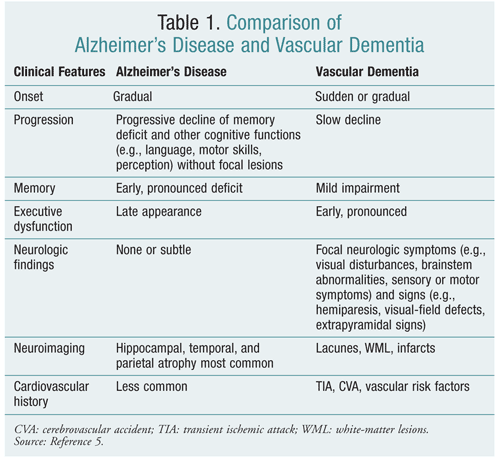
But why is the FAST score so crucial in dementia care, you ask? Picture this: You're trying to assemble a complex puzzle without seeing the whole image. That's how dementia care feels without the FAST score. It provides a clear picture of the progression of Alzheimer's and vascular dementia, giving you a roadmap to follow. It's like having your personal guide in the challenging journey of dementia care.
So, are you ready to embark on this enlightening journey of learning how to use the FAST score? Buckle up, because this guide is about to make your voyage in the sea of dementia care a lot smoother. Let's dive in!
Unraveling the Seven Stages of the FAST Score: A Dementia Guide 📊
The Seven Levels of the FAST Score
- FAST Level 1: No functional decline. The individual is fully independent with no noticeable changes in their cognitive abilities or daily activities.
- FAST Level 2: Very mild cognitive decline. The individual might forget names or locations but is still able to perform daily activities independently.
- FAST Level 3: Mild cognitive decline. The individual may need assistance with complex tasks such as managing finances or planning events.
- FAST Level 4: Moderate cognitive decline. The individual may need help with basic tasks like cooking or shopping and may start to withdraw from social activities.
- FAST Level 5: Moderately severe cognitive decline. The individual may need help with personal care such as dressing or bathing and may experience significant memory loss.
- FAST Level 6: Severe cognitive decline. The individual may need assistance with basic activities such as eating and may experience severe memory loss and confusion.
- FAST Level 7: Very severe cognitive decline. The individual may lose the ability to communicate or recognize loved ones and may require full-time care. Learn more about the different stages of dementia.
Peeling back the layers of the FAST score, we find a roadmap, a guide that helps caregivers navigate the winding path of dementia care. Each level, like a signpost, offers insights into the progression of the disease, and understanding these stages is a cornerstone of effective dementia care for caregivers.
Imagine Level 1 as the starting point, where a person with no cognitive decline lives independently. But as we move along the path, the signs change. By Level 4, subtle changes in complex tasks may be evident. Can your loved one still manage finances? Are they struggling with planning dinner for guests?
As we journey further, the signs become more apparent. Level 6, for instance, often signals significant cognitive decline. Does your loved one require assistance with dressing? Are they forgetting the name of their spouse? These are the signposts of the FAST score, each one a beacon guiding caregivers through the fog of Alzheimer's dementia support.
But what does this mean for you, the caregiver? And how can this vascular dementia tips guide help? Let's delve deeper into the practical implications of each FAST score level. Click here to learn more about determining the stage of dementia a person is in.
Mastering the FAST Score: A Caregiver's Guide to Dementia Care 🎯
Now that we've understood the FAST score and its levels, let's delve into how you, as a caregiver, can incorporate it into your daily care routine.
Utilizing the FAST Score in Daily Care Routine: A Step-by-step Guide






Learn more about Utilizing the FAST Score in Daily Care Routine: A Step-by-step Guide or discover other Dementia Care Tips guides.
By following these steps, you can effectively use the FAST score to guide your care routine. Remember, the FAST score is a tool to understand the progression of dementia and should be used in conjunction with professional medical advice.
As a caregiver, understanding the FAST score isn't just about knowing the stages of dementia. It's about decoding the language of your loved one's journey, adapting your care strategies, and finding ways to connect in each new phase. But how do you interpret these changes over time?
Think of the FAST score as a compass in your caregiver journey. When the score shifts, it's like the needle moving, indicating a change in direction. Your loved one might be needing more help with daily tasks, showing increased confusion, or experiencing changes in their sleep patterns. These are signals for you to adjust your care strategies.
But remember, every dementia journey is unique. Just as no two snowflakes are alike, each person's experience with dementia will be different. So, while the FAST score provides a guide, your intuition, patience, and love are equally important in this journey.
Still, feeling overwhelmed? Don't worry. We're here to provide Alzheimer's dementia support and vascular dementia tips. Together, we'll navigate this labyrinth called dementia.
Now that we've gone over how to interpret the FAST score, let's delve deeper. Here's a video by a healthcare professional explaining the use of FAST score in dementia care.
That was a comprehensive explanation of how the FAST score is employed in dementia care. Now, let's see how well you've understood the concept with a quick quiz.
Understanding the FAST Score in Dementia Care
Test your understanding of the FAST score, its levels, and its use in dementia care with this interactive quiz.
Learn more about 🧠 Understanding the FAST Score in Dementia Care 📝 or discover other Dementia Care Tips quizzes.
FAST Score in Action: Real Stories from the Frontlines of Dementia Care 🎬
Imagine being in the shoes of Mary, a full-time caregiver to her mother who has Alzheimer's dementia. Mary was initially overwhelmed by the rapid progression of her mother's condition. She felt lost, not knowing how to provide adequate support. Then, she discovered the FAST score dementia guide. Using this tool, she could now better understand the stages of her mother's dementia, and it became her roadmap in this challenging journey.
With a clearer understanding of the FAST score, Mary was able to anticipate her mother's needs ahead of time. For instance, when her mother was at level 5, Mary noticed an increase in her forgetfulness. She prepared by labeling household items and creating a daily routine to provide structure. This proactive approach significantly reduced her mother's anxiety and confusion.
Then there's John, a son caring for his father with vascular dementia. John used the FAST score to communicate effectively with his father's healthcare team. With this tool, he could accurately describe his father's current stage and discuss suitable care strategies. Isn't it empowering when you can converse confidently with healthcare professionals about your loved one's condition?
These are just two examples out of countless others showing how the FAST score can be a beacon of clarity in the often foggy journey of dementia care for caregivers. Are you ready to discover how it can help you too?
FAST Score Vs. The Rest: Comparing Dementia Assessment Tools 🔍
Now, let's take a moment to consider other dementia assessment tools. Ever heard of the Mini-Mental State Examination (MMSE) or the Montreal Cognitive Assessment (MoCA)? These are widely used cognitive tests that provide snapshots of a person's cognitive abilities, much like a Polaroid captures a moment in time. But, are they as comprehensive as the FAST score?
While these tools do a commendable job in early detection of cognitive impairment, they lack the precision and depth of the FAST score in mapping the progression of dementia. Imagine trying to navigate a bustling city with only a basic map. That's what using MMSE or MoCA in advanced dementia stages can feel like. In contrast, the FAST score is like a fully-featured GPS, guiding caregivers through the intricate landscape of dementia care.
Remember, understanding dementia stages is crucial in providing effective care. So, while these other tools have their place, nothing quite compares to the detailed roadmap that the FAST score provides. Isn't it better to have a reliable guide when navigating uncharted territories?
Comparative Analysis of Dementia Assessment Tools
Demystifying the FAST Score: Your Questions Answered 🤔
Before we conclude, let's address some common questions and misconceptions about the FAST score.
Remember, the FAST score is a valuable tool in dementia care, but it's only one piece of the puzzle. Always consult with healthcare professionals for a comprehensive assessment. Now, let's wrap up our discussion.
Wrapping Up: Empowering Caregivers with the FAST Score 🎁
And there we have it, a comprehensive dive into the world of the FAST score. A world that at first might seem foreign, even intimidating. But isn’t it a bit like learning a new language? The first few phrases can feel awkward, but with some persistence, you start to see patterns, it starts to make sense. Before you know it, you can have entire conversations in this new language, the FAST score dementia guide.
As a caregiver, you're the unsung hero in the journey of dementia. Your role isn't easy, but with tools like the FAST score at your disposal, it can be a little less daunting. Now you're not just reacting to changes, but anticipating them, planning for them. Can you imagine how empowering that might be?
Think of it as a compass in the dense forest of Alzheimer's dementia support – it won’t clear the path, but it will help you steer your loved one through it. So go ahead, give the FAST score a chance, let it be your guide. And remember, each step you take is a brave journey towards understanding dementia stages, be it vascular dementia or Alzheimer's.
And who knows? Maybe in the process, you'll find that the language of the FAST score becomes second nature to you, a testament to your resilience, your dedication, and your unwavering love.

No comments yet. Be the first to share your thoughts!